

 Print page
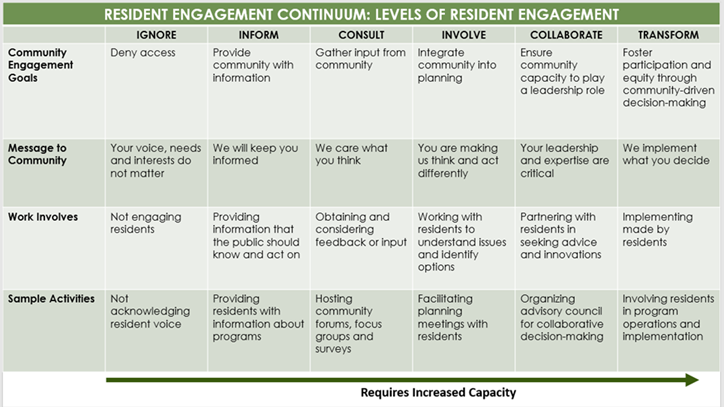
Community Partners of South Florida shared that the resident engagement continuum has been central to many of their programs for years. The continuum ensures that programs understand what their baseline is and realistically how resident-driven a program can be. This can be helpful to discern that any program can have resident-informed/driven aspects. The continuum also helps you to be honest about where you are on engaging residents and identify ways to be more responsive and make changes.
Step 1: Identify Your Place on the Resident Engagement Continuum
Utilize this Resident Engagement Continuum to identify where on the continuum your organization currently engages residents. Consider thoughtfully where your organization typically engages residents now and consider with your team what it would take to implement increased levels of engagement with residents in the planning, design, and implementation of your CHW program. As you move along the continuum, the degree of engagement and therefore difficulty increases, though the benefit and impact of the work also increase. Engaging residents meaningfully in program planning and implementation takes time and will take organizational resources.As you are reviewing the Resident Engagement Continuum, consider this initial question:
- Where are we currently on this continuum and how do we know?
Step 2: Resident Engagement Visioning
Once you and your staff have identified where your organization or department's resident engagement work sits within the continuum, consider the following questions to thoughtfully identify where your organization would like to advance on the continuum.* The recommendation here would be to do this activity with a team of staff. Though there might be a single staff member who might be responsible for implementing resident engagement activities, it is also important to create a team culture that encourages and values resident engagement. Supervisors should participate in these conversations and ensure that resident engagement work is a part of a CHW manager's and CHW staff's workplan.- Where might we want to be along the continuum? Why?
- What might it take for us to increase capacity to engage residents more meaningfully?
- What do we have to gain or lose to operate this capacity?
- What are the results we want to achieve?
- What might be some early actions we can take together? Who will take actions and when?
- What will help us determine if we are successful?
"When implementing resident engagement, particularly if you or organization has not tried this before, take it slow. It takes time and lots of effort to build relationships with residents. Do not get discouraged if progress seems slow. What's important is to keep a spirit that celebrates experimentation, thoughtfully reviews actions, and when something is working, do more of what is working."—Learning lab participant
Step 3: Develop Resident Engagement Action Plan
Once your team has answered the questions above, develop a resident engagement action plan. The resident engagement action plan should include:- Resident engagement goals.
- Key actions.
- Key activities to move actions.
- Who will lead?
- Who will support?
- What supports do I need?
- Timeline? Start and End?
- How will I know this strategy is working?
Step 4: Implement & Track Progress of your Resident Engagement Plan
ONE Neighborhood Builders in Providence, Rhode Island established a COVID-19 response strategy with weekly meetings with community health workers, multiple key organizations, residents and the Rhode Island Department of Health. The coalition identified community needs and coordinated activities to inform residents about COVID-19 and provide health support. They disseminated messages via newsletters, canvassing efforts, pop-up vaccination sites, mobile health clinics and radio announcements. Collectively, this coalition of partners hosted more than 77 pop-up community vaccination sites, administered more than 2,000 COVID-19 vaccines, and distributed about 287,000 masks.
As you start to implement your resident engagement plan, after every milestone of significant action taken or every two to three months host a meeting (virtual or in-person) with CHW staff and managers to consider your progress toward the implementation of the goals you and your team established to advance resident engagement. The following questions can be used to help identify areas of strength in your resident engagement work, and areas where you might need to identify additional supports or resources to advance your resident engagement work.* It is very important that there is not a punitive lens held when asking or answering these questions. Remember, this work is all about learning. The more you create a dynamic learning environment that supports improvement, the better impact you will have and the more the staff will want to continue to iterate and improve program implementation. ONE Neighborhood Builders in Providence, Rhode Island established a COVID-19 response strategy with weekly meetings with community health workers, multiple key organizations, residents and the Rhode Island Department of Health. The coalition identified community needs and coordinated activities to inform residents about COVID-19 and provide health support. They disseminated messages via newsletters, canvassing efforts, pop-up vaccination sites, mobile health clinics and radio announcements. Collectively, this coalition of partners hosted more than 77 pop-up community vaccination sites, administered more than 2,000 COVID-19 vaccines, and distributed about 287,000 masks.
Questions include:
- What were our intended results?
- What were our results?
- What caused our results?
- What will we sustain?
- What will we improve?
- What is our next opportunity to test what we learned?
Community Health Workers: A Promising Program Model to Advance Health & Well-Being in Affordable Housing and Community Development