

 Print page
Two NeighborWorks network organizations embedded a community health worker (CHW) to workforce pipeline after recognizing an opportunity to springboard CHW work into other healthcare careers. These organizations linked CHWs to internships and employment opportunities, created training cohorts and supported the development of soft skills, communications and practical skills.
Step 1: Recruitment of Community Health Workers
Prior to recruitment, an organization should have established guidelines for employment status such as CHW work schedule, intended duration of employment, and payment details. Essential information to convey to CHWs during recruitment include expectations, desired knowledge and skills, background, or experiences (for example, individuals who have been diagnosed with diabetes, individuals living with HIV, etc.), time commitments, required travel, compensation or benefits packages, and career development opportunities. Many of these details are included in job descriptions and are described in further detail below.Once this has been established, an organization is ready to consider channels for recruitment. There are several different ways to recruit CHWs. The first factor to consider is how the CHW will fit into your organization and contribute to the program's goals and success. CHWs should have a strong connection to the communities they serve and be recruited from those communities. Recruitment outreach can be implemented through traditional and non-traditional venues such as:
- Radio and television programming
- Websites and social media such as Facebook, Instagram, LinkedIn, and Twitter
- Newspapers
- Posters and fliers
- Churches and other community groups
- Community meetings (or discussions with community members)
- Recreational centers
- Local colleges and universities
- Schools
- Social events such as dances, fairs, and sporting events
- CHW associations or groups
- Employment agencies
- Word of mouth/ Referrals from current or former CHWs
- Internal recruitment within an organization
Step 2: Hiring Community Health Workers
As part of the hiring process, you should consider if your ask is for staff to conduct in-person home visits. It may seem like common knowledge, but due to the pandemic, people have been hesitant about in-home visits.
In addition, competencies are important to address health disparities and support CHWs to establish themselves as health professionals. Below is a list of general CHW competency domains and definitions:
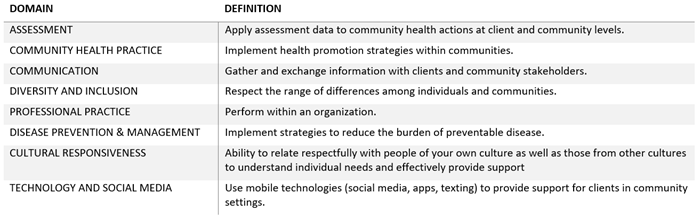
In addition to these general competency domains, many states and national projects have identified additional CHW core competencies that you may want to consider in developing your organization's CHW program. Two resources to consider reviewing are:
- The 2017 CHW Core Consensus (C3 Project) that many states have adopted as their state-wide CHW core competencies.
- The Maine CHW Initiative has created a table of broad competencies required of CHWs, and then more specific attributes and skills pertaining to each larger competency.
"When you hire individuals in the community health worker role, it's worth it to find someone who is from and familiar with the community. Health is such a taboo topic in a lot of communities and having someone who is already trusted or knows where pockets of people would be and can breakthrough barriers is key and makes your program so much more efficient and authentic." —Learning lab participant
Job Descriptions
Formal CHW job descriptions that accurately reflect their roles, responsibilities, and general components such as job title, job purpose, duties, preferred and required qualifications and working conditions. CHW job descriptions should also include:- Primary duties (e.g., home visiting, patient education).
- Workload.
- Educational requirements (e.g., certificate holder).
- Language requirements (e.g., both oral and written, English, other languages).
- Specific skills (e.g., computer skills, EHR experience, phone calling skills, driver's license).
- Personal skills (e.g., empathy, ability to develop trusting relationships, interest in helping the community).
- Physical requirements (e.g., transporting education materials, walking and stair-climbing to visit patient homes).
- Prior health and other related work experience (including knowledge of CHW community).
Once you have identified core competencies and have a formal job description, you are ready for the hiring process. This will include conducting an interview to assess potential CHW candidates' skills and experience. You can include other members of your team in the interview process, including program leadership, other CHWs, and even members of the target community. Interviews may incorporate role-playing exercises and activities to assess problem-solving and/or relational skills. During the interview, your team should get a sense of the candidate's comfort level with specific tasks (i.e., talking with clients and community members about sensitive topics). Hiring managers and leadership can compare interview results and performance against the criteria for the position (a simple scoring sheet can be used to do this). Once an agreement has been made on preferred candidates, CHWs should be hired and integrated into the CHW program. A comprehensive guide for recruiting and hiring CHWs, including questions to consider during the interview.
"A strong team will increase community engagement and allow for referrals to begin to come from residents as well as referrals. What I have found to be important is hiring those who have skills with working with people and also training commumity health workers outside of the initial certifying community health worker program." —Learning lab participant
Step 3: Supervising and Supporting Community Health Workers
A supervisor's role is vital to providing the CHW with the needed resources and supports to be effective in their jobs. The supervisor is a part of the management team and helps CHWs be productive in their daily work. They are the direct link between management and workers and check in on the progress of work, frame expectations, and assess performance. In addition, they must establish good relationships and ensure a supportive work environment. Programs should identify a person responsible for supervising CHWs, which could include an individual with a public health background, a social worker, a healthcare provider, an experienced CHW, or a related role.Regardless of their background, all supervisors should receive training on the history of CHWs, CHW roles and responsibilities, communication, and effective supervision strategies so that they can best support the CHW team. The supervisor must ensure they have enough time to dedicate to this role, including regular supervision meetings, performance reviews, and other supportive activities. Supervision can take place on an individual and/or group basis, although group supervision provides an opportunity for CHW staff to learn from each other and build a community of support among themselves.
According to MHP Salud's Supervision Manual for Promotora de Salud Programs, regular supervision meetings are beneficial to:
- Check-in with CHWs and discuss workplan activities and workload
- Conduct team-building exercises
- Review documentation and data
- Provide feedback on progress and performance
- Encourage prioritization and integration of resident engagement
- Identify training and resource needs
- Discuss and address issues or challenges, such as burnout
- Commend accomplishments
"We've tried to be mindful that community health workers (CHW) are directly from the community or represent the community that we serve. We believe it's equally as important for CHW supervisors to represent the community. This role is key in supporting residents with lived experience, a supervisor is an advocate and a mentor and determines what "success" looks like." —Learning lab participant
Step 4: Consider Training Curricula and Approaches for Community Health Workers
Basic Education and Training Qualifications
Orientation and on-the-job training are essential for onboarding a CHW and integrating them as a new member of your team. Following the recruitment and hiring process, it is important for an organization to have mechanisms in place to provide hands-on training for their CHWs. Such training may include soft skills, technical skills, interactive components as well as mentorship.More specific training requirements for the new CHW will depend on organizational practice, setting, and job duties. For example, CHWs working for community-based organizations (CBO) could receive core competency training augmented by health outreach and advocacy training to provide health information and conduct outreach. CHWs working for a health-focused CBO could receive competency training as well as training in chronic conditions to facilitate access to primary care and implement community health activities. CHWs working in a community health clinic or ambulatory care setting could receive core competency training supplemented by disease-specific training such as asthma, cancer, or diabetes in order to facilitate access, care coordination, or provide disease and treatment-specific information.
In addition, CHW performance could be enhanced by training including topics such as:
- Awareness of organizational culture
- Buy-in and ongoing organizational support from leadership
- Education on specific health topics to be addressed
- Education on specific social service topics and resources
- Introductions to clients/patients by existing staff members
- Introduction to provider, care team, and support staff
- Job shadowing of provider, care team, and support staff as well as other CHWs
- Orientation to organizational history, logistics, policies, and procedures
- Training in EHRs and other computer software
Training Curricula for Community Health Workers
Training curricula should be robust and should differ from program to program, recognizing each community has unique needs. Many states offer CHWs training curricula, however, the topics vary across program types. The table below includes various curricula topics broken down into knowledge and skill categories and shown by the CHW model types:- Model 1: Enhanced Resident Service Coordination Model in Multiunit Affordable Housing
- Model 2: One-Stop Shop Model to Address Multiple Social Needs (Community Action Program, Community Building and Engagement, Comprehensive Community Development)
- Model 3: Health Condition-Focused Models
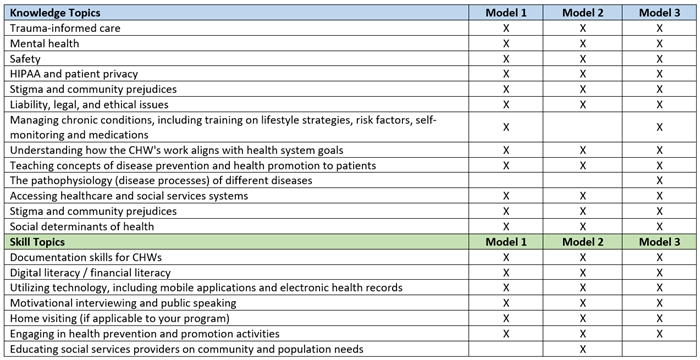
CHW training curricula should also encourage time to practice newly learned skills, role-playing prior to interacting with patients and community members, team-based exercises, self-care practices, and shadowing other CHWs in the field, if possible. Examples of CHW training curriculums can be found below:
- Wright State University Medical School 21 – week CHW course/ certification program curriculum: Community Health Worker Curriculum
- Community Health Worker Network of New York City, 35-hour curricula: Comprehensive Skills Training for Community health workers: 35-hour Course of Study
- Montana Office of Rural Health and Area Health Education Center, CHW training curricula: Community Health Worker (CHW) Training
- Washington State Department of Health, Manual for in-person and online training: Training Curriculum for Community health workers
Community Health Workers: A Promising Program Model to Advance Health & Well-Being in Affordable Housing and Community Development