


For Providence Community Housing, helping people return home has always been central to its mission.
Founded in 2006 to restore housing and bring displaced New Orleans residents back to their communities after Hurricane Katrina, the NeighborWorks® network organization has spent two decades strengthening homes and neighborhoods in a region where severe storms are a recurring reality.
Today, Providence provides quality, affordable housing to more than 3,300 people throughout Greater New Orleans. The nonprofit’s work has evolved from restoring damaged properties to rehabilitating aging buildings and constructing new homes designed to better withstand future disasters. 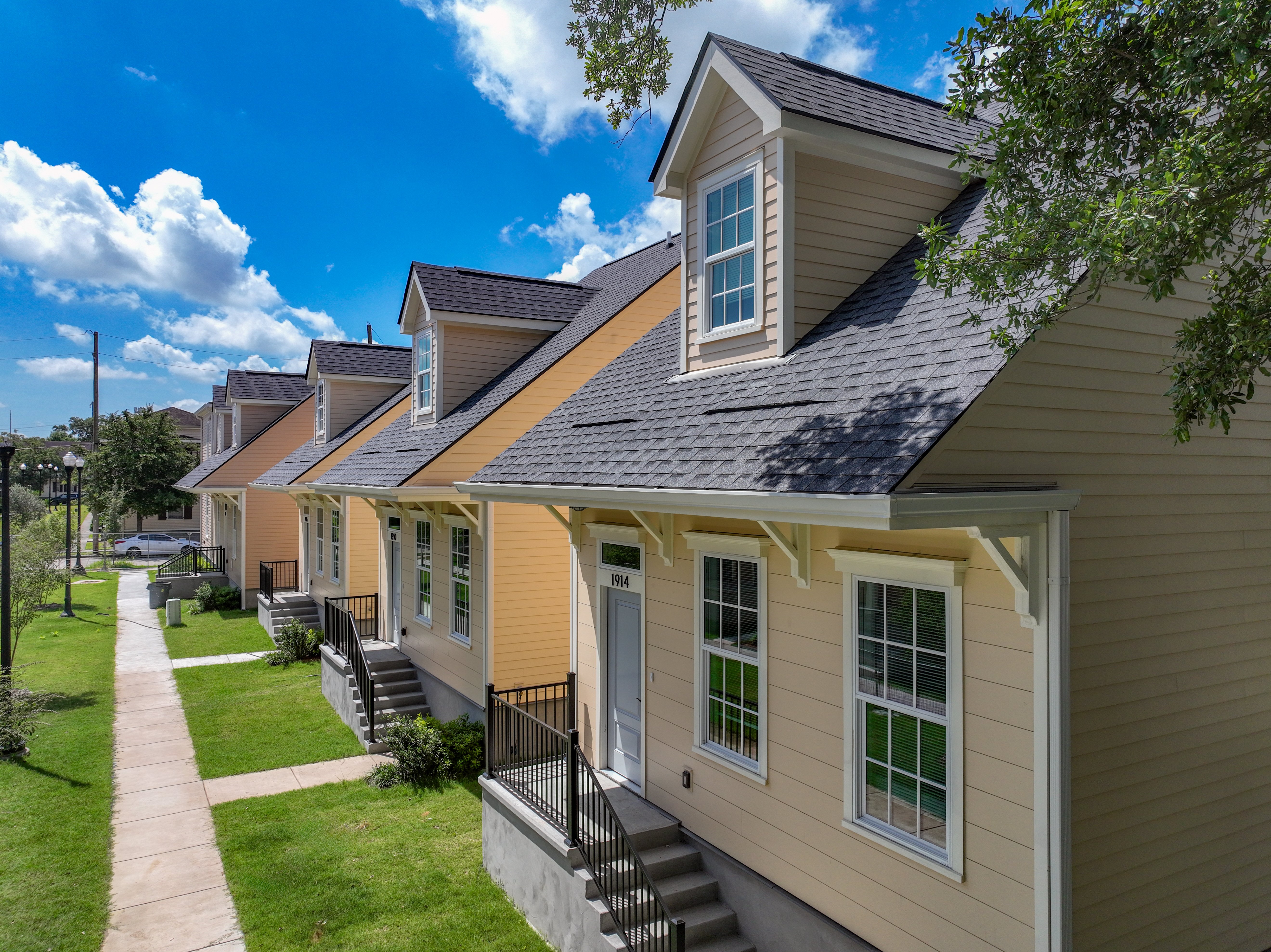
For Terri North, president and CEO of Providence Community Housing, that commitment to resilience means making investments today that will benefit residents and their communities for years to come.
"The materials are more expensive upfront, and the techniques and things are different," North said. "But we have stayed committed to that."
Building to last
That commitment helped shape Faubourg Lafitte, a mixed-income development in New Orleans' historic Tremé-Lafitte neighborhood.
Working with Enterprise Community Partners, Providence engaged residents in envisioning a community that reflected the surrounding neighborhood while incorporating more durable, energy-efficient construction. Most of the development consists of smaller residential buildings, with features such as wind-resistant windows and other protective measures designed to withstand severe weather.
"We took a lot of pains in making sure that the construction methods that are used, wind-resistant windows, things of that nature, would make sure things would hold up better going forward," North said.
Those investments were tested in 2021 when Hurricane Ida brought damaging winds to the region. While some Providence properties experienced significant damage, Faubourg Lafitte fared considerably better.
"We experienced only minor damage at Lafitte, which sort of proves out the point that this resilient building really does work," North said.
Built to Enterprise Green Communities’ , the development also incorporates energy-efficient features that help lower utility costs for residents. Providence's commitment to resilient construction is also beginning to yield financial benefits.
Following Hurricane Ida, insurance premiums surged across the region, creating significant financial pressure for affordable housing providers. Providence initially faced the risk of steep increases despite relatively few losses at many of its properties.
While broader market changes have helped ease premiums, insurers are also placing greater emphasis on individual properties, including construction methods and history of storm damage. For Providence, years of investing in durable materials and documenting how its buildings perform have helped demonstrate the value of that approach.
"We have well-built construction, and our loss history reflects that, so that is starting more and more to be taken into account," North said. "And that is bringing the rates down."
The lower premiums provide financial relief, preserving resources that can instead support Providence's work to maintain and improve affordable housing.
And the benefits can extend beyond individual properties. North points to growing efforts across Louisiana and other Gulf Coast states to help homeowners install FORTIFIED roofs. Certified by the Insurance Institute for Business & Home Safety (IBHS), FORTIFIED roofs make small but impactful adjustments in roof design that significantly reduce the risk of wind and water damage. As more buildings incorporate protective features, entire communities may become more attractive to insurers.
"It's not just about that single person's premium," North said. "It's about a player coming into the marketplace and going, ‘Oh, 50% of their inventory is FORTIFIED. Okay, maybe we can play in this space.’" The proactive approach demonstrated by Providence and local community members has had a knock on effect, keeping insurers engaged in the market and premiums more manageable for households.
For Providence, investing in homes designed to withstand severe weather is about more than protecting individual properties. It's about minimizing damage, reducing the risk of displacement and helping residents remain rooted in their neighborhoods.
“I cannot impress upon you enough how remarkable Providence’s success with insurance premiums is,” says Cormac Molloy, NeighborWorks’ Director of Sustainability & Resilience.
For three years, a survey of the NeighborWorks network has measured the cost of insurance for multifamily owners and operators. Nearly every organization has seen above-inflation premium increases, sometimes substantially. “Premium increases above 25% or even 50% were not uncommon the last few years. To see rates in a New Orleans portfolio stay the same or fall is a testament to proactive investments in communities, buildings, and people.”
Investing in healthier homes
Providence, now celebrating its 20th anniversary, is also applying its long-term approach to older properties, replacing aging roofs and windows, upgrading HVAC systems with more efficient equipment such as heat pumps, and making improvements inside individual apartments. 
The work goes beyond protecting buildings from severe weather. Updated flooring, energy-efficient appliances and healthier building materials are helping to create more comfortable living environments while reducing energy and water consumption.
"First off, it'll make their unit look lovely, and that is important to the resident, just the resident experience of living in a nice new place," North said. "We're making sure that the appliances are conserving energy and water, and making sure that the healthy materials we are using benefit our residents."
The improvements can also help Providence manage long-term operating costs, supporting its commitment to preserving affordable housing. To support that work, Providence actively pursues funding opportunities that can help make substantial improvements possible.
Through a special HUD program for multifamily preservation and energy efficiency, the organization secured three grants, including a $12 million award supporting improvements initially planned for the 150-unit St. John Berchmans Manor. Providence is combining that work with improvements at the 51-unit Delille Inn, extending the benefits to more residents. The award is projected to reduce energy costs by 20-25%, easing pressure on operating expenses while creating a healthier, more future-proofed community.
"It's about making existing buildings more resilient," North said. "So we were all over it. We wanted as many of our buildings in this as we could possibly get."
The organization also explores other financing mechanisms and local programs that can help reduce property operating costs, including property tax arrangements tied to economic and resident benefits.
For North, these investments reflect lessons learned from the urgency of restoring housing after Katrina, when getting displaced residents home quickly sometimes meant prioritizing immediate repairs over longer-term improvements.
"You don't want to just put band-aids on problems," North said. "You really need to take the time to assess what you need and try to finance what you need so that it can last."
Preparing for what comes next
Providence isn’t slowing down, either. The organization recently participated in a Sustainability Accelerator Cohort with nine other NeighborWorks organizations. Customized technical assistance also helped Providence identify a strategy for long-term sustainability resilience planning across the organization’s portfolio, from major renovations to changes in lighting fixtures. A grant for implementation will help advance these efforts. 
“Despite all the Providence team has already accomplished, it’s impressive to see them continuing to plan for what comes next,” says Molloy.
The resilience extends beyond the buildings themselves.
For North, one of the most important lessons from years of responding to hurricanes is that organizations must prepare not only for the storm, but for what happens afterward.
"First of all, you really need to have some really good disaster planning," North said. "And a lot of folks stop at the ‘pre-’."
That means establishing clear responsibilities, maintaining reliable communication systems and investing in technology that allows employees to work from wherever they are. During Hurricane Ida, those preparations helped Providence respond quickly, even as staff members faced disruptions and losses in their own lives.
"In Ida, really kind of without a beat, we knew who was in charge of what, who to listen to, how to communicate," North said.
That preparation proved especially important after Hurricane Ida displaced 13 families from one of Providence's properties. Rather than wait for delayed insurance payments, Providence found a way to finance the repairs and bring those families home sooner.
"So we found a way, because that's what we do; we found a way to get them back in sooner before we were paid," North said. "But we had to scrounge to figure that out, and I'm very proud of that."
The experience reinforced how critical it is for organizations to have plans, resources and flexibility to continue serving residents when disasters disrupt normal operations.
"You do need your team, but also have to be sensitive to what people are dealing with," North said, noting that employees may be coping with damage or displacement themselves.
Laying a foundation for the future
North encourages other NeighborWorks organizations to take a long-term approach to resilience, from investing in durable building materials to documenting improvements and developing comprehensive disaster recovery plans.
Even when resources are limited, organizations can begin learning about resilient construction, exploring funding opportunities and planning for future improvements. Enterprise Green Communities and HUD offer training resources to help organizations build that knowledge.
As communities across the country confront hurricanes, wildfires and other natural disasters, North believes organizations should begin preparing before they face a crisis.
For Providence, that preparation is part of a continuing commitment to helping people not only return home, but live in healthier homes and more resilient communities.
"Do not wait for the disaster," North said. "Even if you're thinking 'I don't have the money right now to do any of this stuff,' that's okay. You're laying a foundation."