

 Print page
Content Informed By: Melissa Nemon, Melissa Nemon Consulting
Published October 26, 2023
Executive Summary
- Differentiate and document network organizations' imperatives for action and changing response work as the pandemic progressed.
- Identify network organizations’ expanded roles beyond their known affordable housing and community development into being stabilizers, trusted partners, and community anchors.
- Explore how network organizations' response work, coupled with their expanded roles, can generate bridging new opportunities to building thriving equitable communities.
Sustained & Varied Responses Throughout COVID-19
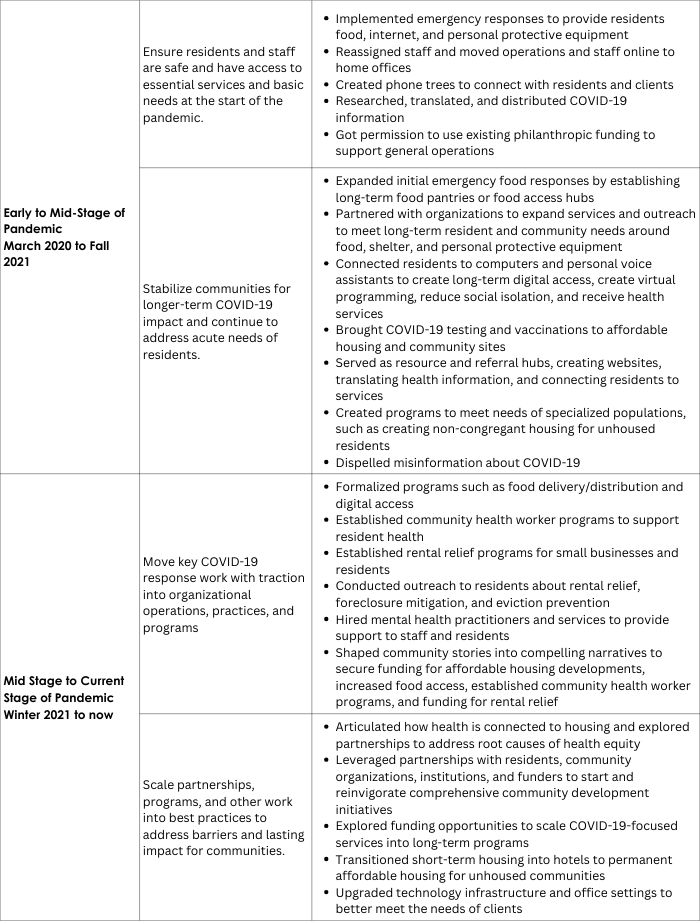
As we heard from the network through the focus groups and combing through NeighborWorks reports of other network organizations' COVID-19 responses, we started to group the different responses. Through sorting the responses, we identified four imperatives of the network in their response work and mapped their responses to the imperatives. To help sort the network’s responses and support our sensemaking of what the network has shared, we started to group the responses based on the network’s imperative in four areas:
- Ensure residents and staff are safe and have access to essential services and basic needs.
- Stabilize communities for COVID-19 and continue to address current needs of residents.
- Move key COVID-19 response work with traction into organizational operations, practices, and programs
- Scale partnerships, programs, and other work into best practices to address barriers and lasting impact for communities
We also notice the imperative for response work and action shifted in the pandemic from early to mid-stage and then from mid-stage to now. This helped us to understand the complexity of the network’s COVID-19 response and identify where the field might be heading as we look to reorient our collective affordable housing and community development work toward creating thriving, resilient communities.
NeighborWorks Network Pandemic Responses
Expanded Roles of the NeighorWorks' Network to Meet the Moment
In mapping the network responses and identifying their imperative toward action, we noticed patterns in their work that went beyond their often-sought-after community roles as housing developers, lead agency, or service provider. Network organizations expanded into roles as stabilizers, trusted partners, and community anchors.
As stabilizers, the network provided residents in their affordable housing and wider communities with support to meet basic needs, provided technology and other digital training supports and built partnerships to bring COVID-19 resources, testing, vaccination, and information to residents.
As trusted partners, network organizations successfully communicated pertinent COVID-19 information in accessible ways and in multiple languages. Network organizations worked with their funders to redirect their funding in ways that their organization needed to support their operations best and meet residents' needs. Many funders agreed to this redirection as they trusted network organizations, recognized their key role in meeting the community's needs, and also wanted to ensure their continuity throughout COVID. In addition to pivoting funding, network organizations received new funding and filled gaps in their communities by creating new programs and services to meet the acute needs of their communities. In being stabilizers and trusted partners, network organizations expanded into being community anchors.
Community anchors are institutions focused on community-based strategies, bringing people together across divides, engaging the public and sparking innovation. While they are not always in the lead, community anchors focus on issues and underlying conditions for change and care about a community’s narrative. While some network organizations were already considered anchors in their communities, many organizations stepped into this new role throughout the pandemic. Network organizations shared stories of what was happening in communities to secure funding and resources, built new partnerships, deepened their relationships with residents and leaders, generated new programs, scaled emerging work and maintained a focus on keeping communities connected.
As COVID-19 has entered a phase in which majority of society reverts to the norm and the federal government ended pandemic emergency in May 2023, network organizations remain in a ready position to continue to drive bold solutions to address resident and community disparities. The network's actions over the previous three years and their expanded roles have positioned them well to transition to implementing comprehensive solutions to build thriving, resilient communities.
Transition From an Urgent Response to a Comprehensive Approach With a
Building Mindset
Near the begining of the pandemic, the NeighborWorks network evolved and assumed new roles, which they have continued after pandemic emergency response ended. Their responses throughout the pandemic have been critical to meeting needs, stabilizing communities and making clear the challenges that are preventing communities from thriving. In analyzing their response, network organizations were not responding just to keep their communities from getting COVID-19; they were addressing a myriad of social, behavioral, and economic needs that are precipitated by structural inequities. The opportunity exists to continue to expand the efforts while also looking at ways to build stronger, more resilient communities that offer equitable opportunities to thrive.Sparked by the murder of George Floyd, the pandemic coincided with a growing movement to eliminate racial and social inequities. The disparate impacts of the pandemic on low-income communities and communities of color also called out the need to think systemically about the root causes of disparities and inequities. The pandemic – and its numerous social and economic impacts – combined with the focus on civil rights also highlighted the need to re-center the voices and priorities of residents living in the most impacted communities. Across the NeighborWorks network and the broader community development field, these concurrent events resulted in a renewed commitment to resident-led, place-based, and comprehensive approaches.
NeighborWorks defines comprehensive community development as an intentional approach aimed at improving lives and strengthening communities. Comprehensive community development rests on several core principles, including a shared vision; layered strategies applied in a specific location; residents engaged as critical stakeholders in planning, implementing, and evaluating those strategies; and shared leadership provided in collaboration with cross-sector stakeholders.
Working comprehensively is not a new concept or approach. Its origins go back to the beginning of the community development movement. But as NeighborWorks network organizations created new programs, forged cross-sector partnerships and assumed new roles as community anchors, many began to shift their focus from offering singular services toward more holistic or system-level strategies. These approaches seek to address underlying causes through muti-layered and collaborative approaches. They also seek to improve outcomes for entire communities, not just for individuals who participate in specific programs.
The following table illustrates how this shift from urgent, novel approaches toward more systematic strategies occurred within the NeighborWorks network:
|
Health Services Providing COVID-19 information, testing and vaccinations on-site at network-owned affordable housing properties and community sites |
Health Services Establishing community health worker programs to liaison between residents and health care providers to meet COVID-19 health needs, and providing other health service supports at network-owned affordable housing properties and community sites |
Prior to COVID-19, St. Mary Development Corporation in Dayton, Ohio operated a robust resident services program at its multi-unit properties. Throughout the pandemic, resident services staff provided a variety of supports to residents, addressing COVID-19 and general health. This helped them determine the need to hire a community health worker to expand services. |
|
Mental Health Addressing isolation among seniors, youth (among and others through virtual connections and events |
Mental Health Utilizing trauma-informed care and healing-centered engagement to hold conversations with residents about their experiences as a pathway to healing and community action |
New Kensington Community Development Corporation in Philadelphia, Pennsylvania launched a Trauma-Informed Community Engagement Toolkit that captures the work it does with its staff and communities to understand trauma and its effects and develop tools to build resilience and emotional well-being. |
|
Food Access Operating food pantries, gift card distribution and delivery services. |
Food Access Working to address the barriers in place-based food systems, such as building partnerships to bring grocery stores to neighborhoods, helping establish cultural food businesses and creating referral pathways to Supplemental Nutrition Assistance Program benefits for residents |
Chinatown Community Development Corporation, focused on the Chinatown neighborhood of San Francisco, California, launched a Feed + Fuel program to connect low-income residents with restaurants in Chinatown to receive continuous food access. The program has also helped keep restaurants open, alleviating unemployment. |
|
Affordable Housing Placing unhoused residents in short-term hotel rooms |
Affordable Housing Transforming short-term hotel rooms into permanent, affordable housing units for unhoused residents |
Champlain Housing Trust in Burlington, Vermont transformed interim housing in hotels and motels used throughout the pandemic for unhoused residents into permanent affordable housing units. |
|
Digital Access Providing access to the internet and connected devices |
Digital Access Partner to transform interim Wi-Fi mesh networks into sustainable internet access points by sharing stories of residents and how long-term, affordable internet access creates opportunity |
Community Partners of South Florida in Riviera Beach, Florida is members of a community coalition working to bring digital access to all residents in South Florid, addressing the digital divide of broadband access, devices and training. |
In observing the shift from urgent responses to comprehensive approaches, we offer several recommendations:
- Meaningful Resident Engagement: Comprehensive efforts succeed when they address resident priorities and engage residents themselves in meaningful and sustained ways.
- System-Aware and Equity-Centered Support: Comprehensive efforts assess current conditions, recognize the history of places, and seek to address the underlying causes of disparities and inequities.
- Strong Partnerships: Comprehensive approaches require partnerships, as no single organization has the capacity to realize a community’s vision. Partnerships with residents, nonprofits, government, community institutions and others build long-term capacity.
- Sustained Effort and Funding: Achieving meaningful change requires sustained effort, resources, and long-term investment.
Building on these lessons and recommendations, NeighborWorks offers an expanded set of resources to assist network organizations in deepening their comprehensive approaches. This includes funding, training, coaching and peer-to-peer learning that equips organizations to work across sectors, connect their strategies to a community vision, develop community-led plans, assess long-term change, and elevate success stories. Through these resources, we will continue to support organizations that are seeking to build on their pandemic response efforts in order to have a more lasting and holistic impact.
Conclusion
The resilience of the NeighborWorks network has never been more evident as these organizations have nimbly risen to address the needs of their communities throughout the COVID-19 pandemic. The pandemic pushed many NeighborWorks network organizations into an elevated level of response. Through their varied responses, organizations supported communities to stay healthy, expanded their roles and reach in their communities, and highlighted the imperative to implement comprehensive approaches.COVID-19 also laid bare inequities across the community’s network organizations, often driving much of the urgency of the network’s response work. As COVID-19 recovery enters a new stage with the ending of the pandemic emergency, this moment requires new ways of working to create thriving, resilient communities. Now is the time to support the network and the larger affordable housing and community development field to transition from urgent approaches to comprehensive orientations and approaches. With this shift, we must take the opportunity to scale the response and work extensively to have a greater impact in rebuilding communities now so that we might withstand whatever and whenever the next crisis comes. As we enter a stage in which we have to live with COVID-19 as part of our daily lives, we must consider new ways of working to create thriving, resilient communities.
Context Setting: Emergence of COVID-19, the Network & NeighborWorks
NeighborWorks America, formally known as the Neighborhood Reinvestment Corporation, is a Congressionally chartered nonprofit organization dedicated to creating places of opportunity in communities across the country. For nearly 45 years, NeighborWorks has been leveraging its national reach and expertise to build technical skills and organizational capacity, supplement financial resources, and amplify the efforts of local and regional nonprofit organizations to improve their communities. From its position as an intermediary, NeighborWorks brings together partners from across the nonprofit, for-profit, and public sectors, acting as a bridge to achieve lasting results. NeighborWorks’ flexible resources catalyze critical investments in communities, setting the stage for participation from additional partners and leveraging significant additional resources. Building on this solid foundation, in FY 2024, NeighborWorks will continue to create opportunities for people to live in affordable homes, improve their lives, and strengthen their communities.
NeighborWorks America supports a network of nearly 250 nonprofit housing and community development organizations, which provide on-the-ground support to families and communities in every state, the District of Columbia, and Puerto Rico. These organizations are developing service-enriched rental housing to address affordable housing needs, spearheading community stabilization and engagement activities to revitalize neighborhoods affected by economic downturns or natural disasters, and working to rebuild pathways to improved credit, savings, and sustainable homeownership for low- to moderate-income families and families of color. NeighborWorks organizations also provide an array of other community-focused services related to health, education, and workforce development.
When COVID-19 closures began in March 2020, NeighborWorks network organizations moved quickly to stabilize operations and communities. Network organizations faced keeping staff healthy and employed, ensuring residents had their basic needs met, finding new ways to communicate, and transitioning to online operations. The swift closures left many residents struggling to access basic necessities such as food and personal protective equipment. Social distancing limited residents’ access to critical programming offered by the network. Organizations also had to figure out ways to keep residents and staff safely isolated but connected. To pivot operations, the network initially spent over $60 million, with $7.2 million to support technology for telework and virtual service delivery and $10.3 million in overtime pay for staff (NeighborWorks COVID-19 Survey).
As COVID-19 continued and the demand for services increased, the network responded and expanded its capacity. Collectively, the network hired over 1,000 staff for newly created positions and minimally furloughed or laid off staff (NeighborWorks COVID-19 Survey).The expansion of the network’s capacity was aided by funders, including NeighborWorks, who allowed organizations to shift their proposed grant deliverables to general operations and funded new programs and services that responded directly to residents’ needs. New funding from local and federal governments and the Paycheck Protection Program, helped stabilize organizations and launch critical response work. Nearly all network organizations applied for the Paycheck Protection Program (PPP) and collectively received $134.2 million in funding (NeighborWorks COVID-19 Survey). This funding supports stabilized organizations and creates the pathway for them to expand their programs and take on a “stepping up and stepping in” approach to fill gaps in their community when other organizations could not meet demand. Through this expansion, network organizations met residents’ varied needs, including providing over one million services to residents in the first year of the pandemic, with nearly half of the services for food access and basic necessities. They were also able to implement novel and innovative approaches to decrease the digital divide, save business districts and create pathways for residents to stay in their homes and communities.
Network organizations also created new or expanded partnerships with healthcare agencies in their communities. Early in the pandemic, many agencies were having difficulty connecting with vulnerable populations and marginalized communities. With their established community ties, many network organizations were approached by these agencies to make connections with residents to share COVID-19 information and consider partnerships for COVID-19 testing and vaccinations. Many network organizations distributed and translated COVID-19 information to residents and combatted misinformation. Several network organizations opened their affordable housing properties and other owned community sites to provide on-site testing and vaccination clinics for residents and their staff.
As organizations responded to their communities, NeighborWorks mobilized to provide multiple means of support to the network. Leading the way for other funders, NeighborWorks immediately provided unrestricted funding to help network organizations navigate the months immediately following initial closures. This funding helped the network transition to use technology in new ways, including embracing web conferencing applications and helping staff members create home offices for remote work. Funding was also used by the network to train staff and residents on remote accessibility, along with establishing Employee Assistance Programs to help with the emotional toll of the pandemic. Network organizations also used unrestricted funding from NeighborWorks to reduce unexpected costs of continuous cleaning procedures, procurement of personal protective equipment and extended medical leave.
Along with redirecting its funding, NeighborWorks provided support to network leaders by hosting peer learning opportunities and connecting organizations to timely capacity and technical assistance support; NeighborWorks held weekly executive director sessions to exchange information and understand how others were managing the pandemic, including internal stressors for staff and ways to mitigate burnout, and deployed a temporary and optional COVID-19 survey to understand the evolving impact of the pandemic on the network and its operations.. NeighborWorks provides individualized and direct support to network organizations through its relationship manager staff members, who are liaisons to the network. Relationship managers submitted timely information to NeighborWorks that was key to informing how it could deploy grants and other resources to the network quickly and meaningfully.
As the pandemic continued beyond the first few months, NeighborWorks network organizations noted not only an increase of residents needing supports to meet basic needs, but there was also an increased need for financial education, eviction prevention, rental relief and foreclosure mitigation as low-income households tried to remain stable amid changes in the economic job market. Nine in 10 network organizations conducted outreach or counseling to inform community members about eviction moratoriums and mortgage or rental relief options. Network organizations also experienced the impact of COVID, losing $143.4 million in rental collections from March 2020 to April 2021.
Similarly, as addressing rental relief became a priority issue for communities across the country and the network, NeighborWorks was named in the American Rescue Plan Act of 2021 to administer a $100 million counseling program nationwide. The Housing Stability Counseling Program (HSCP) funds eligible nonprofits and agencies that provide direct counseling services to individuals and families facing eviction, foreclosure, or homelessness. As this program is geared to both network and non-NeighborWorks network organizations, this funding has been providing critical support to communities across the country to address foreclosure and rental counseling needs, particularly in low-income and communities of color.
These significant efforts helped explore NeighborWorks’ learnings from COVID-19 pandemic responses and how NeighborWorks and the network can build thriving, resilient communities.