


For most Americans, homeownership is the primary vehicle for building wealth. It provides stability, equity and a stake in the future. But for millions of households, the gap between that promise and reality has been widening for decades.
With many Americans being priced out of the traditional market by rising costs and stagnant wages, the dream of homeownership remains out of reach. The divide between owning and renting compounds over time. When the market shifts, rents rise, or landlords sell, renters bear the consequences without the protections that ownership provides.
Shared equity housing helps close that gap.
Through five multiyear congressional appropriations totaling $12 million, NeighborWorks® America’s Shared Equity Housing (SEH) Initiative engaged more than 100 network organizations across the country, leveraged $135 million in additional capital, and helped over 1,200 families become homeowners between 2019 and 2026.
What’s more, these homes are in communities where ownership would otherwise have been unattainable, and the shared equity models ensure those homes remain affordable for the families who come after them. NeighborWorks’ investment strengthened the foundation of the field, as documented in a report on the Shared Equity Housing Initiative released last month.
Today, we turn the spotlight on NeighborWorks Northeastern Pennsylvania to demonstrate the initiative’s impact.
In Scranton, Pennsylvania and across Lackawanna County, rising housing costs are reshaping a community long defined by affordability. After years of post-industrial decline, the region is experiencing renewed investment and population growth, driven in part by new institutions, shifting migration patterns, and an anticipated Amtrak passenger rail expansion.
These new developments compound challenges that have been building in the region for decades. An aging housing stock requiring costly deferred maintenance, low production of new single-family homes, and a large older adult population without options to downsize have resulted in a Shared Equity Housing Initiative market that is increasingly unaffordable at both ends. 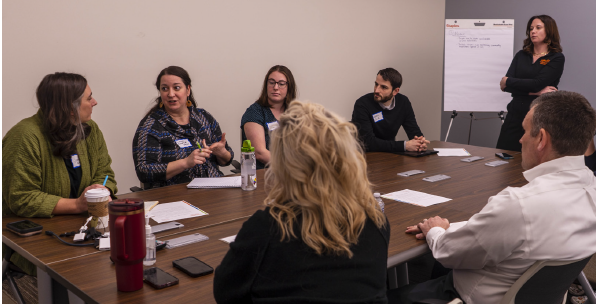
“There is a housing bottleneck,” said Shane Powers, president & CEO, NeighborWorks Northeastern Pennsylvania (NWNEPA). “Not only are there really not a lot of smaller homes that are cost-effective for first-time homebuyers, there’s very little for older adults to downsize to or right-size. And so this bottleneck creates a lack of suitable options for first-time homebuyers and small families.”
Meanwhile, new construction tends toward market-rate or premium rental products, and remote work trends following the pandemic have already pushed rents upward, making the affordability gap more acute even before any rail-driven demand materializes.
For NWNEPA, these conditions signaled an urgent need to explore new approaches to preserving affordability and expanding access to homeownership. Shared equity housing offered a solution that would address the bottleneck at both ends, but required careful exploration, community alignment, and cross-sector collaboration.
With support from NeighborWorks® America’s Shared Equity Housing Initiative, NWNEPA began a structured feasibility and planning process to determine how shared equity models could work in their local context.
From Exploration to Alignment
The first phase of NWNEPA’s work through the Shared Equity Housing Initiative focused on building knowledge and alignment, both internally with staff and board members and externally with community stakeholders and partners. To help determine the right model to address the organization’s needs, NeighborWorks America brought national shared equity expertise directly into the local conversation.
Through the initiative, NWNEPA was matched with Brenda Torpy, a technical assistance provider from Champlain Housing Trust – one of the country’s most established community land trusts and a NeighborWorks network organization.
Torpy traveled to Scranton to work alongside staff and community partners, providing direct, in-person engagement that gave NWNEPA hands-on support tailored to local conditions, including sample documents and model structures. The connection, made possible by the initiative’s support, helped translate national best practices into a locally grounded strategy.
Building Partnerships for Implementation
As momentum grew, NWNEPA became part of a broader, coordinated effort to explore the feasibility of shared equity housing in Scranton. NWNEPA convened more than 30 community leaders, including representatives from the City of Scranton, the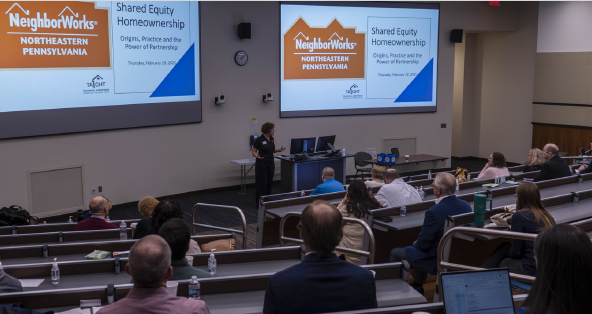 Scranton Redevelopment Authority, the Scranton Area Community Foundation, United Neighborhood Centers of Northeastern Pennsylvania, and the Lackawanna County Land Bank, to explore how shared equity housing could work locally and what role each partner might play in its development and long-term stewardship.
These convenings built a shared understanding among stakeholders who had never encountered shared equity housing before and created space to surface concerns and align on strategy.
The Scranton Area Community Foundation emerged as a key partner, committing funds specifically to shared equity housing and serving as a convening force for ongoing coalition work. Together with public, nonprofit and community development partners, the foundation helped build the shared understanding and local alignment needed to move the model forward.
The technical expertise and community partnerships helped steer the organization toward selecting a deed-restricted shared equity model. Unlike a community land trust, which requires an organization to permanently hold title to land, in a deed-restricted model, affordability restrictions are written into the home’s deed, ensuring that when it is sold, it must be sold at an affordable price to another income-qualified buyer. The subsidy stays with the house without the organization needing to own the land beneath it.
This model aligned naturally with NWNEPA’s existing strengths in buyer education and one-on-one counseling. The model also addressed the organization’s focus on older adults and right-sizing. Price restrictions can be structured to keep homes affordable for residents on fixed incomes, and equity can be passed to family members without income restrictions, countering a common concern that shared equity limits intergenerational wealth.
With this foundation in place, NWNEPA completed its first shared equity home sale using the deed-restricted model in 2025. NWNEPA also recognized that sustained, accessible education would be essential to making the model work at scale. The complexity of resale rules can be disorienting for buyers unfamiliar with shared equity.
In response, NWNEPA began developing broader community education programs targeted at prospective buyers, older adults considering right-sizing, and residents who may not yet see themselves as homeownership candidates.
Two additional homes are now in the pipeline. These single-story properties on Lackawanna County Land Bank lots target older adults at 50% and 80% of Area Median Income looking to downsize into stable, affordable homeownership rather than enter assisted living or remain in homes they can no longer adequately maintain.
Early Results and What Made Them Possible
NWNEPA’s participation in the Shared Equity Housing Initiative produced outcomes that would not have been achievable without it. The initiative opened access to a national network of expertise that a 19-person organization in Scranton could not have built on its own.
“It opened up doors to other technical experts and resources we didn’t know existed,” said Powers. “And now we’re not only building those resources, we’re bringing that expertise to this region, which serves residents broadly.”
The initiative also provided the operational bandwidth, through staff time, consultant access, and funding for community convenings, that allowed NWNEPA to build momentum at a pace the organization could sustain. The technical groundwork established through the initiative translated into real dollars.
The feasibility work, coalition building, and community education directly supported NWNEPA’s successful application for $400,000 from the Pennsylvania Housing Finance Agency to fund the construction of new shared equity homes. “I certainly don’t think that we would have been as successful in securing funding from Pennsylvania Housing Finance Agency to go build those two new houses if we hadn’t gotten this funding on the front end and done the pre-work,” said Powers. “It gave us technical credibility in that Shared Equity Housing Initiative application; it was something that we had taken the time to learn about.”
Looking Ahead
Having completed the feasibility and planning work and the pilot with two homes under construction, the organization is looking toward implementation at scale. NWNEPA is actively pursuing that next stage, including a multi-year grant to fund a dedicated director of affordable housing initiatives and conversations with for-profit developers about partnerships that could expand the pipeline beyond what scattered infill can produce.
The bottleneck that defined Scranton’s housing market four years ago is the same one NWNEPA is now equipped to address, with a proven model, committed partners, and a clear path forward. The model that was once theoretical has provided a real foundation for the future of shared equity housing in Lackawanna County. It is embedded in NWNEPA’s strategic plan, backed by local partners and public funders, and the stage is set to produce homes for families who had few options before.
“When we originally applied, we knew so little,” said Powers. “And I don’t know if any of us really knew enough to say what could this look like for the organization – how powerful this could be from an affordability standpoint.”